- The Job
- Posts
- Infrastructure Skills
Infrastructure Skills
Green jobs are now just good jobs, as community colleges continue to invest in the energy transition.

Paul Fain
April 30, 2026
Training for clean energy careers moves beyond a niche focus amid strong demand. Also, expanding on-ramps to skilled construction jobs, career navigation as a public good, experts predict AI breakthroughs but surprisingly little economic disruption, and essays on how apprenticeships can rebuild the learning curve and on the potential for prediction markets to help track AI job disruption. (Subscribe here.)

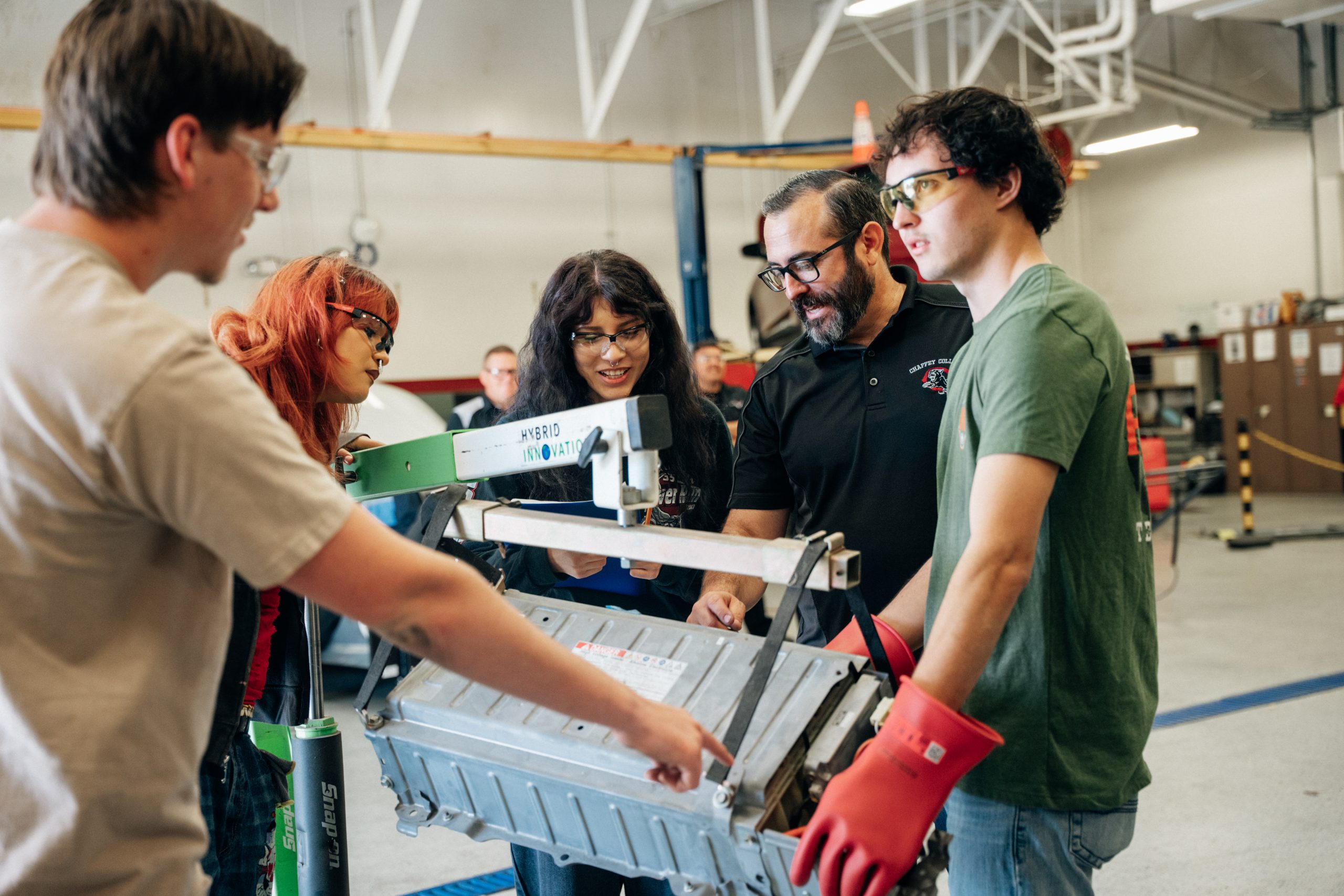
An auto tech lab at Evergreen Valley College. (Courtesy of Foundation for California Community Colleges)
Community Colleges Shed ‘Green Jobs’ Niche
As recovery dollars began flowing from the federal government during the Great Recession, community colleges across California—like much of the country—began investing in workforce training programs in solar energy. But when some of those jobs never materialized, the colleges and students felt burned.
“The industry wasn’t ripe yet, and the labor market wasn’t there,” says Jeffrey Clary, senior director of climate strategies at the Foundation for California Community Colleges. “Today, you’re not going to see programs that are pipelines for one job. Instead we’re training students to be mobile and adaptive.”
The Big Idea: Community colleges in California and across the country haven’t moved away from so-called green job training—far from it. They’re investing more and more every year. But they’ve moved beyond the niche focus, in part because of lessons learned about the risk of overspecialization and in part because the nature of climate and sustainability work has shifted.
It’s less a “green” industry unto itself and more just another part of every business. Auto mechanics, for example, now need to know about repairing electric vehicles. Welders in some states need to know how to work on renewable energy equipment, like windmills. In California, community colleges are incorporating green job training elements into fields like agriculture and forestry.
Growth in that kind of training remains strong, even as the Trump administration targets offshore wind and rolls back incentives for the green energy transition, including working with Congress to end tax credits for electric vehicle purchases. The tenor of the conversation has changed, but the experts and college leaders Work Shift spoke with say that dates to Biden-era investments in infrastructure and pandemic recovery.
Work that was once sold as a societal good, even if it slowed growth, is now viewed as a major engine of economic development.
“There’s been some pushback on the idea of calling things ‘green jobs,’ because it tends to conjure up wind and solar and that’s it,” says Rachel Rosen, director of MDRC’s Center for Effective Career and Technical Education. “It’s actually much more expansive and really impacts almost every job you can think of when you start digging into it.”
Work Shift this week takes a deeper look at how community colleges across the country, including in California, Illinois, Iowa, and New York, are adapting. Click on over to read the full story. —By Colleen Connolly
— Sponsored By —

Demand for non-degree credentials has never been greater, and neither has the need for rigorous research to guide the field. Join 30+ scholars, practitioners, and federal policymakers at the NCRN Spring Conference for conversation on Workforce Pell, the value of credentials, navigating non-degree programs, and more. Register here.
On-Ramps to Union Apprenticeships
The data center boom is driving up demand for skilled construction workers. To help meet that urgent need, North America’s Building Trades Unions have partnered with Microsoft and OpenAI to try to expand the workforce pipeline into the skilled trades.
TradesFutures is part of that effort. The workforce intermediary promotes on-ramps to union apprenticeships and careers in construction. It was created by NABTU and industry partners before becoming a stand-alone organization in 2023.
Interest is surging across the TradesFutures network of 200+ apprenticeship-readiness programs in 34 states. Those programs enrolled 7,700 people last year. They seek to expose jobseekers to skilled construction careers, expanding access for an industry where opportunities are typically found through word of mouth.
TradesFutures works with both organized labor and industry management. The financing varies for its affiliates, with unions typically providing in-kind support, such as space and tools. But every affiliate operates its own apprenticeship, says Marina Zhavoronkova, executive director of TradesFutures.
“We feel confident that we’re placing someone in a career,” says Zhavoronkova, who was a senior adviser to the U.S. Commerce Department’s CHIPS Program Office during the Biden administration. She says the registered apprenticeships graduates move into are safe, pay good wages, and offer a path forward.
The group this week released a report on the network’s apprenticeship-readiness programs. It found promising practices as well as common barriers, including widely varying placement rates into apprenticeships.
Nearly half of the surveyed programs cited a limited availability of local apprenticeship slots, for example. And roughly a third said a common problem is completers who aren’t job-ready or placeable into apprenticeships.
The most important factor in overcoming these challenges is a strong, sustained relationship between the apprenticeship-readiness programs and unions, the report found. These should be multilevel partnerships, including direct relationships with training directors, to understand trade-specific expectations.
Managing enrollment is also important, Zhavoronkova says. Programs should seek to ensure that the supply of graduates matches apprenticeship openings. They also should screen applicants to ensure that they meet minimum requirements for local apprenticeships, like a GED or high school diploma.
Money, however, is at the root of key problems identified by the report. For example, many of the programs are small grassroots organizations with a few staff members. The lack of capacity can prevent them from connecting participants to apprenticeship opportunities and supporting them through placement. Likewise, the programs often lack the operational infrastructure needed to apply for and manage funding.
“The funding need is huge,” says Zhavoronkova. “With full resources, these programs could collectively place thousands more students into union construction apprenticeships and careers.”


Investments to support effective career navigation should be viewed as a public good, argues a new report from researchers at the Project on Workforce at Harvard University.
Career pivots are common and increasing in frequency among the low-wage workers and community college students who were surveyed and interviewed for the study. Their career changes typically are driven by external shocks, including layoffs, shifting caregiving responsibilities, health challenges, immigration, academic misalignment, or the vagaries of the business cycle.
Half of the career moves by this group of workers and students are lateral or reactive, not upward. While they are flooded with information about careers—on job boards and AI-enabled platforms—that information often is unreliable or difficult to interpret without guidance.
As generative AI changes jobs and workers experience more shifts, the report finds that a lack of career navigation support may exacerbate economic gaps.
“We’ve built a labor market where AI is speeding up change, but haven’t built the systems to help workers respond to that change—so the burden falls on individuals,” says Kerry McKittrick, co-director of the Project on Workforce and a co-author of the report. Joe Fuller, co-head of the Managing the Future of Work Project at Harvard Business School, was another co-author.
Family and friends were the most common sources of career information for both the workers and community college students included in the study. And because social networks typically are stratified by income, this can limit exposure to higher-paying jobs that may have more mobility or stability.
The report calls for a stronger career information infrastructure and investments in career coaching across the education-to-work continuum.
McKittrick says policymakers are starting to recognize the need to provide stronger resources for career navigation. For example, more than half of policy advisers to governors mentioned navigation in recent interviews with the project’s researchers about workforce policies.
Investments in talent marketplaces also are headed in the right direction. But tech is only part of the story, McKittrick says, and we continue to underinvest in the human infrastructure needed to make those tools work.
The Kicker: “We’ve spent a long time focusing on the skills gap, but I think it’s just as important to address the navigation gap,” she says. “I’d love to see more policymakers addressing this head-on.”
Big Capabilities, Modest Economic Impacts?
AI is legit, with capabilities that will significantly expand during the next few years, according to a wide range of experts. Yet 69 leading economists predict that key U.S. economic indicators—including GDP, total factor productivity, and labor force participation—will remain within the band of historical trends.
That’s the surprising central finding from an important new working paper by researchers from the Forecasting Research Institute and co-authors from the Federal Reserve Bank of Chicago, Yale School of Management, Stanford University, and the University of Pennsylvania. The National Bureau of Economic Research published the paper.
In addition to the group of economists, the forecasting exercise surveyed 52 AI industry and policy experts, 38 accurate forecasters, and 401 members of the general public. The survey was conducted from October through February. Its findings are summarized here by the Forecasting Research Institute, which includes a tool for comparing your projections with those from the economists.
While the economists expect significant AI-driven shifts to the job market, they didn’t envision the sort of transformative economic effects some have predicted.
For example, under a scenario of rapid AI progress by 2030, they predicted that:
U.S. labor force participation would decline to 59.3% from 61.9%.
By 2050 it would slide to 55%.
About half of that decline—roughly 10M lost jobs—would likely be attributable to AI rather than demographics and other non-AI trends.
The reasons economists cited for their view of relatively modest impacts included adoption lags, demographic headwinds, policy responses, potential infrastructure bottlenecks, and long-standing patterns in how general-purpose technologies affect the economy.
Even so, the predictions varied widely, particularly when assuming the technology progresses rapidly.
Respondents were asked about six possible policy responses to AI’s economic impacts: retraining support, modernized unemployment insurance, universal basic income, a Manhattan Project for AI, a compute tax, and a job guarantee program. The economists were most supportive of job retraining, with 72% backing that approach. But they gave this policy just a 10% chance of becoming a reality.
Open Tabs
State Data
The need for better labor market data will only grow as policymakers grapple with the impacts of AI on jobs, economic volatility, and structural change, William Congdon and Will Raderman write for the Brookings Institution. Enhanced unemployment wage records are a promising option, they write, but state experiences show that success depends on stable federal administrative funding, common guidelines, and time for iterative implementation.
Policy Choices
As the AI economy reshapes work, the choices made now by our nation’s leaders will determine whether this transformation deepens existing inequalities or strengthens shared prosperity, according to the National Skills Coalition. The group calls for policymakers to build the data infrastructure to understand and anticipate the tech’s impact on work, to prioritize continuous skill building, and to support stable transitions from job loss to re-employment.
Workforce Pell
Maryland’s policy for Workforce Pell implementation is out for public comment. The approach is integrated with the state’s Eligible Training Provider List, so funding streams can be braided and outcomes can be tracked immediately, writes Rachael Stephens Parker, executive director of the Maryland governor’s workforce development board. The policy makes room for regional variation, including the use of regional data for programs to qualify as being in-demand.
Incarcerated Students
Workforce Pell could open up opportunities for the 1.1M people incarcerated in state prisons, writes David Pitts for the Urban Institute. But policymakers would need to formulate guidelines in a way that recognizes the unique challenges of offering programs to people in prison. Pitts says this could be done without undermining quality. For example, he proposes an earnings test that compares grads with formerly incarcerated nonparticipants.
Job Moves
John Bailey, an expert on technology and policy, will be the first AI fellow at Heartland Forward, a nonprofit policy think tank. Bailey, a nonresident senior fellow at the American Enterprise Institute, will help inform policy conversations around AI as a tool for economic competitiveness across the 20 heartland states.
Thanks for reading. If this newsletter was forwarded to you, subscribe here. —PF