- The Job
- Posts
- Local Talent
Local Talent
California community colleges take on the shortage of primary care physicians.

Paul Fain
October 08, 2026
A California program seeks to shrink primary care deserts by building a clear path from community college to medical school and then back home again. Also, practical advice for state policymakers on closing gaps between K–12, college, and jobs, with a look at how a controversial tax credit could be a big federal funding source for career pathways in public schools. (Subscribe here.)

Palm Springs, Calif. Photo by Zachary Vessels via Pexels.
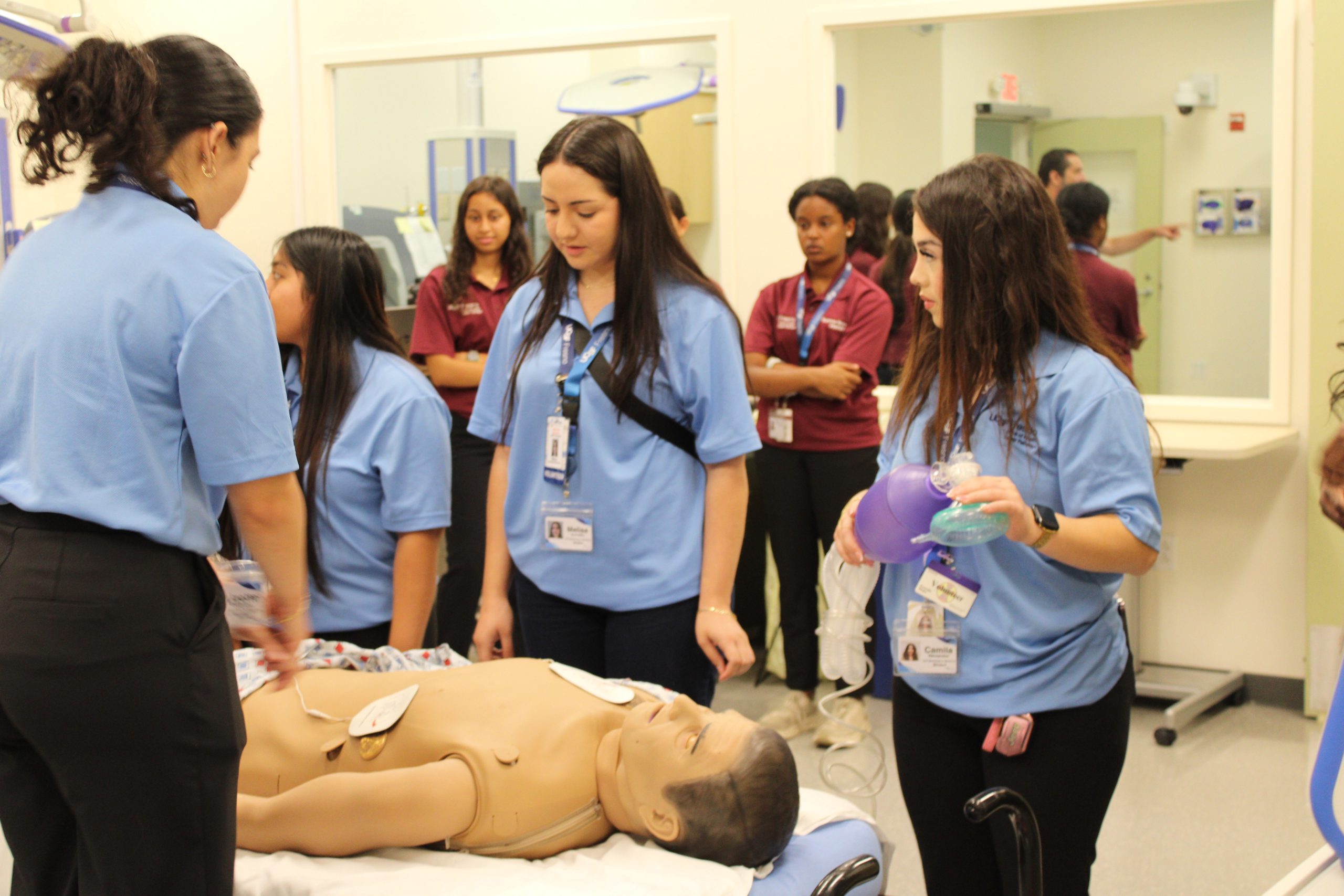
From a young age, Melisa Acevedo, 26, learned how to advocate for family members with health problems. She and her family emigrated from Mexico to rural California when she was 7 years old, and while her community was largely Spanish-speaking, the doctors they saw were not.
“They didn’t receive the best care in some of those clinics due to the language barrier. Being the one translating, it was very difficult to see,” Acevedo says.
Often, people in her small town in the Central Valley had to travel hours just to get any care at all. As she got older, Acevedo wanted to help change that. So did a group of educators and physicians who got together a decade ago and dreamed up what became the California Medicine Scholars Program.
Started in 2022, the program offers a community college–to–medical school pathway with intensive support, including mentoring, paid internships, and help with transportation and financial challenges. It has the twin goals of helping students like Acevedo make it through medical school—and addressing an acute shortage of primary care doctors, especially in the rural areas that are home to more than 2M people across California.
In Tulare County, where Acevedo is from, there are more than 2K residents per primary care provider, and her town is in a designated health professional shortage area.
“When we’re talking about our primary care shortage, specifically in rural areas, we want to make sure that students come back and serve their community. Community college students are more inclined to do that,” says Kaitlin Jackson, director of the statewide California Medicine Scholars Program.
Networking, Not Stacking: The California Medicine Scholars Program is supported by philanthropy and a one-time state contribution of $10.5M. The program operates four regional hubs, growing to six, that bring together community colleges, four-year universities, medical schools, and community health partners. It represents a targeted approach to the challenges of transfer—tailored to one specific professional field—that have long bedeviled community college students. It also broadens the lens on how community colleges can serve the healthcare workforce.
Community colleges train the majority of entry-level workers in healthcare, according to Maria Cormier, a senior research associate at the Community College Research Center. A small but growing number of two-year institutions are also now offering four-year nursing degrees in states that allow it. But most healthcare pathways that start in community college focus on stacking credentials—for example, certified nursing assistant to licensed practical nurse to registered nurse—as a way to move students to higher-paid and more advanced roles. The success is varying.
“In theory, stacking makes sense,” Cormier says. “It’s a great model, and healthcare has been one of the few sectors that’s been able to stack pretty successfully, but we’re still not seeing people come back and actually take advantage of that.”
The California Medicine Scholars Program doesn’t rely on stacking. While some students come into the program as certified medical assistants or other related entry-level roles, only students without degrees and who are first-time community college students can apply. The program offers some certificates, in things like CPR, but the focus is on getting them to a four-year university and then medical school.
Thus far, it has enrolled more than 800 students, over half of whom are first-generation college students. About 58% also are from racial and ethnic groups that are underrepresented in medicine, with Latino students comprising the largest share. As of a year ago, the most recent data, three-quarters of the first cohort of the California Medicine Scholars had transferred to a four-year institution, mostly to UC Davis, UC Riverside, UC San Diego, and Fresno State. And a few have already made it to medical school as well.
Most students in the program joined soon after high school, but about 20% started at community college later in their 20s. Alec Jimenez, for example, joined the program after he returned to his hometown of Riverside following four years as an Army combat medic. Now 28, he was recently accepted to medical school and plans to eventually work in internal or emergency medicine.
And he plans to stay in Riverside.
Read the full article on Work Shift to hear more from the students, and for an in-depth look at the challenges California’s rural community colleges face as they work to address primary care deserts. —By Colleen Connolly
Creating Pathways to Economic Mobility
A newly completed series of policy briefs describes how to better connect K–12 schools, postsecondary education, and workforce systems. They’re aimed at state policymakers and account for the current political and fiscal environments while trying to offer concrete, realistic solutions.
Arnold Ventures funded the briefs, which were written by former policymakers. A virtual event this afternoon will feature co-authors of the series and state policy experts. (FYI: While we’ve written a few times recently about Arnold Ventures’ work, the philanthropy doesn’t fund our reporting.)
The final paper, published this week, focuses on how states can identify occupations that are likely to provide economic mobility for students in an AI-infused economy. It follows three briefs that describe:
How to combine multiple state and federal funding sources to improve state career pathways initiatives, with write-ups on leveraging Workforce Pell grants and the Federal Scholarship Tax Credit.
How to reauthorize Perkins—a roughly $1.4B annual federal investment in CTE programs across K–12 and postsecondary education—and improve federal pathways policy.
How states should create an effective and coherent career pathways system by incentivizing the right mix of models.
Not surprisingly, a solid workforce and education data infrastructure is required for many of the improvements called for in the briefs. For example, a reauthorized Perkins should count a pathway as high-quality if it leads to a credential employers actually value and a career that pays a family-sustaining wage, that brief argues.
However, states lack an adequate grasp of how credentials fare in the job market, and struggle in particular to track the performance of short-term education and training programs.
Gaps exist in the data, acknowledges Spencer Sherman, a consultant and co-author of the briefs. But that’s a solvable challenge, he says, because accountability needs to come first.
“If policymakers set accountability standards, that will force the data system to catch up,” says Sherman, who previously held several positions at the Rhode Island Department of Education and oversaw the agency’s data team. “The reverse is not true: If you wait for data to get better before you do any accountability, you'll be waiting forever.”
He says Workforce Pell is an example of the federal government learning this lesson. Most states don’t have the data systems to meet the program’s requirements, but they’re hustling to build them. The briefs encourage state policymakers to use Workforce Pell as a forcing mechanism and a window of political opportunity for improving data systems.
The AI brief says the new federal grant program can be a tool for states to identify which occupations to prioritize. State policymakers also should invest in longitudinal data systems, implement enhanced wage records, and incorporate data from national AI labor market researchers.
Cash Infusion: The Federal Scholarship Tax Credit is getting plenty of attention in education policy circles. Yet the strongly partisan reactions have focused on private school vouchers, largely ignoring what it could mean for public school career pathways programs.
The tax credit, which is slated to take effect next year, could yield an estimated $2.7B to $6.1B in annual funding, notes the series. That money could be used for work-based learning (through transportation to employers or job-training sites), after-school CTE programs, career advising, industry-recognized credential exam fees, equipment, dual-enrollment course fees, and more.
States need to decide whether to participate by January. Nearly all red states have opted in, while most blue states remain undecided. Despite the major equity concerns blue states have with the program, Sherman expects that it will be hard to turn down the new funding source. And the money is likely politically safe for the rest of the Trump administration.
Sherman says he wouldn’t have voted for the program if he was a member of Congress. But it exists and most states will likely opt in.
“If you don’t plan for how it will help public school students, you’re guaranteeing that it won’t,” he says. “Congress may be giving you lemons, but you should start making some lemonade.”
Open Tabs
AI Transition
The economy could create more jobs in the next decade than will be replaced by automation, but the change may require the most intensive workforce transformation in U.S. history, according to the McKinsey Global Institute. An estimated 11M workers may need to transition into new occupations by 2035—more than tripling the typical annual job-transition rate. Declining jobs will be concentrated in office, retail and sales, and transportation roles.
Data Center Jobs
Citing the broad backlash to data centers, Matt Garman, CEO of Amazon Web Services, announced an Amazon commitment to spend an additional $1B over five years to back free community college and hands-on workforce training for residents of communities where its data centers are located. AWS is establishing agreements with community colleges and plans to launch the program in the next few months, with a goal of connecting 300K+ students to “free degree access.”
Free Community College
New Yorkers between the ages of 25 and 55 next year can begin enrolling in a SUNY or CUNY associate degree program in a high-demand field for free, even if they hold a degree in a different area. Governor Kathy Hochul cited potential impacts of AI on the workforce in rolling out the expansion to New York’s free community college program. It seeks to help workers pivot, reskill, or transition into new roles across cybersecurity, advanced manufacturing, and other growing industries.
Re-Enrollment and Completion
A program designed to re-engage stopped-out students at four Florida community colleges increased re-enrollment rates by nine percentage points and nearly doubled the percentage of students who earned an associate degree in the first semester, finds a study by MDRC. The Re-Enrollment and Completion Team (REACT) initiative combines multimodal outreach, advising, and tuition and fee waivers for students who are within 15 credits of a degree.
Job Moves
Joe Arnold is the founder and president of the new Texas Workforce Alliance, an employer-led organization focused on workforce policy. Arnold since 2019 has been deputy vice chancellor and executive external relations officer at the Texas State Technical College system.
Thanks for reading. If this newsletter was forwarded to you, subscribe here. —PF