- The Job
- Posts
- Nursing’s Broken Path
Nursing’s Broken Path
Nursing school wasn’t built for workers who start out as nursing assistants and want to move up. Can that change?

Paul Fain
December 04, 2025
Nursing is billed as a stackable path, but it doesn’t work that way for hundreds of thousands of workers who start out as certified nursing assistants. We took an in-depth look at why and who’s working to change that. Also, Montana is adapting LERs to the culture of the state’s Blackfeet Nation, and Verizon moves from reskilling to outskilling its laid-off workers. (Subscribe here.)
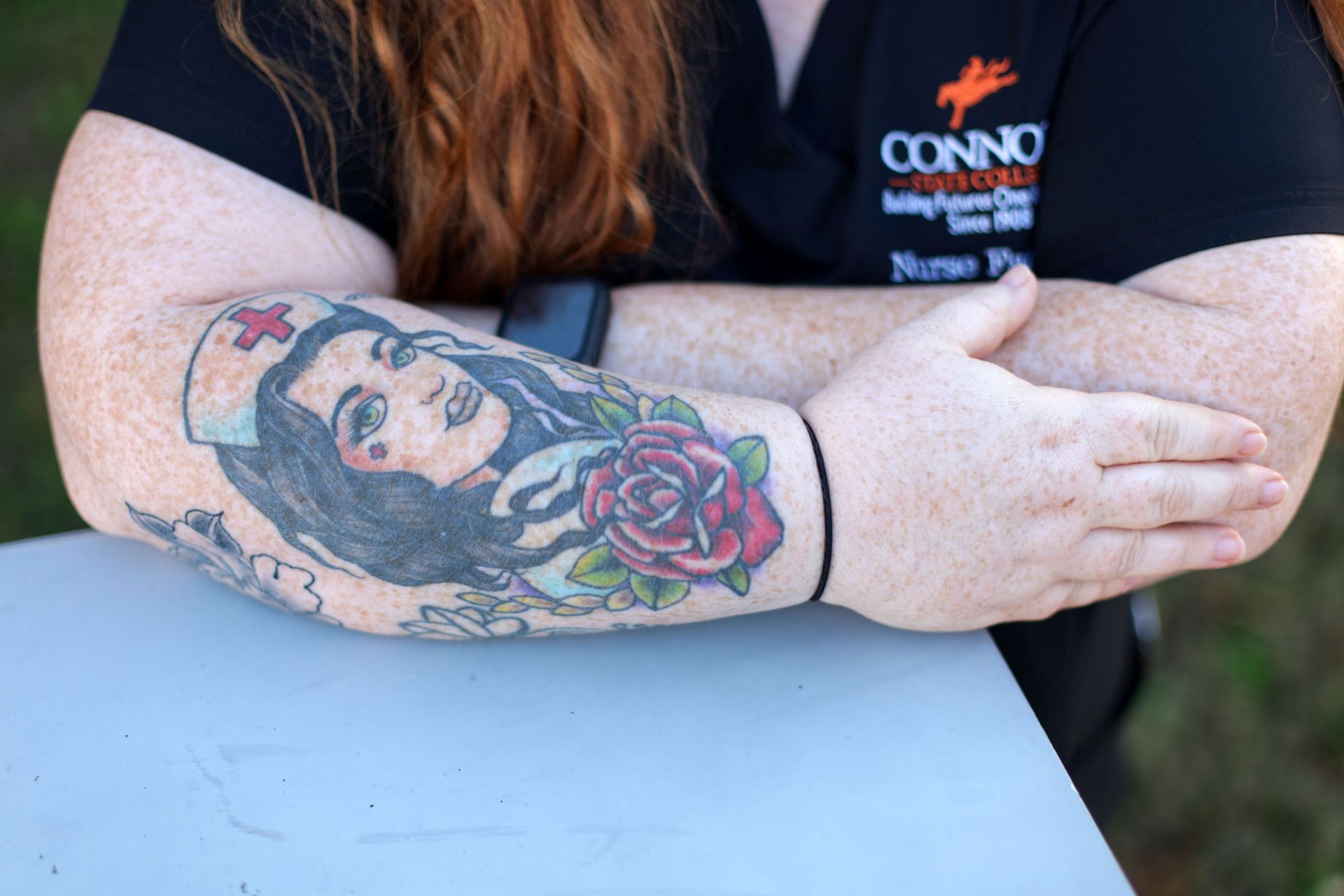
Photo by Mike Simmons for Work Shift
Can We Fix Nursing’s Broken Path?
Latoia Arnett trained to be a certified nursing assistant in 1999 and hoped to quickly move on to become a nurse. She’s been in patient care ever since, juggling the responsibilities of raising three kids while often working double shifts.
Twenty-six years later, she’s still not a nurse.
“I have all this knowledge working in healthcare,” Arnett says. “I just feel like I need to be compensated for it.”
Amid a nationwide nursing shortage, elevating workers like Arnett seems like an obvious solution. Many CNAs and medical assistants aspire to be nurses—in fact, many assistant training programs sell the idea that you can start there, quickly land a job, and then continue on to become a nurse. But the route from CNA to nurse isn’t so much a career ladder as it is a huge leap.
For a Work Shift series that starts this week, reporter Colleen Connolly spent six months talking to CNAs about their experiences and interviewing a small but growing number of health systems, state agencies, and colleges that are rethinking pathways into nursing for entry-level workers. All agreed the status quo isn’t cutting it.
Read the full story on Work Shift.
The Numbers: While there are no national statistics about the number of entry-level healthcare workers who move on to higher-paid positions, a study of federal grants for CNA training showed that only 3% of those who completed the training went on to pursue further education to become a licensed practical nurse or RN. A similar study in California showed that 22% of people who completed CNA certificate programs at community colleges went on to get a higher-level healthcare credential, but only 13% became RNs within six years.
And when the path hits a dead end, workers are locked in essential—but grueling—jobs that typically pay less than a living wage. Susan Mayer, chief learning officer at Achieving the Dream, which is overseeing a project to diversify nursing pathways at community colleges, likened the problem to early childhood education—another low-wage but essential career.
“Our communities need CNAs,” Mayer says. “But we need to partner in ways that enable them to have career pathways, if they choose, to give them information so they know there are options beyond this.”
What’s Changing: Three years ago, Achieving the Dream gave 10 community colleges $300K to improve nursing programs. Many of the colleges either directly or indirectly tackled the problem of low mobility among CNAs or other entry-level jobs.
Northern Virginia Community College developed a competency-based program in which people who had been CNAs could get prior-learning credit and enter an accelerated LPN-to-RN program. Kingsborough Community College in Brooklyn and Pierce College in Lakewood, Wash., changed their admissions policies to include lived experiences and work history instead of only test scores.
Separately, when Monroe Community College in Rochester, N.Y., decided to start offering a CNA program in 2019, it focused from the start on career pathways and the support students need to continue on. And several of Alabama’s community colleges, with leadership from the state and local healthcare systems, have ramped up degreed apprenticeships in nursing that allow students to start working in the field before completing their education.
High schools, too, are thinking about how they can accelerate the pathway from first job to nurse. (In coming weeks, Work Shift will publish an article on that strategy, as well as one on nursing apprenticeships.)
“There’s been more of an openness, not just on the education side, but also on the provider side within hospitals,” Dana Chandler, a deputy director at HOSA-Future Health Professionals, told Connolly.
New Opening: There’s also an opportunity now, as states prepare for federal Workforce Pell grants, to rethink how CNA and other entry-level healthcare programs are designed.
As Connolly was wrapping up reporting for the nursing series, we had a chance to talk with Kelli-Marie Vallieres, chief workforce officer for Connecticut, about how her state is approaching Workforce Pell and stackable credentials more broadly. Healthcare pathways are an important part of that effort.
Connecticut is working to get a handle on the more than 100 different CNA programs offered by colleges and other providers, Vallieres says. The state recently consolidated its 12 community colleges into one unified system, which she hopes will lead to more consistency in program design and how noncredit courses feed into degree programs.
“We can now say, ‘Here are our CNA classes, and what do we need to do to award credit or bundle these courses?’” Vallieres says.
As with other efforts bubbling up across the country, the state’s pathways from CNA to nursing won’t be built overnight. But, Vallieres says, “It’s in process.” —By Colleen Connolly and Elyse Ashburn
Read the full article on Work Shift, and check back next week for more in the nursing series.

The Language of Skills, and a Nation
When Montana began experimenting with learning and employment records two years ago, they knew they’d be a test case for how the tools can best be used in a large, sparsely populated state.
“Because LERs are new, we wanted to work from the beginning on what it meant to implement them across not just Montana's urban centers, but also rural and indigenous communities,” says Jenny Harms, executive director at Accelerate Montana, the economic development nonprofit that led the work as part of the SkillsFWD initiative.
That meant the project spanned from Billings to the Blackfeet Nation.
As Accelerate Montana began working with the tribe, with more than 17K enrolled members, it quickly hit a wall with the skills data that would ultimately feed into the LERs. None of the descriptors that had already been vetted seemed to fit the work that was most needed and valued on the reservation. So, what started as a data exercise quickly became a conversation about culture.
The Blackfeet Nation is rooted in a set of living principles that don’t easily translate into Western culture or the English language. The principles are illuminated and passed down through stories with nuances that a single word doesn’t capture, Wendy Bremner, a member of the tribe and a consultant on the project with 4 Poles Educational Consulting, said at a recent event.
Take the principle of Aatsimoyihkaan. “A simple English definition of that, it could be said as ‘prayer,’” Bremner says. “But it's actually that, in your daily living, you’re practicing walking in a sacred way at all times. And people that come in to be hired need to be competent in that, just as much as we require any other competency.”
The skills library Accelerate Montana was using was open source, so project leaders set about creating their own taxonomy. Thus far, they’ve defined and registered nine living principles that might show up in a job description. They also started offering training on what those principles mean and how they translate to the workforce. People outside the Blackfeet Nation have asked to take it.
The process also led tribal leaders to rethink some of the ways in which education and work function on the reservation.
Lona Running Wolf, a partner in 4 Poles and a tribe member who was a leader on the project, says education and employment systems on the reservation had been designed to align with broader American structures and workplace norms. Not enough thought was given to whether they actually fit the Blackfeet Nation, she says.
“It eliminates opportunity and access because it doesn’t look at people the way that we used to,” she says. “So we recognize that even in the workplace there's work that we have to do.”
But the systems are deeply ingrained, and Running Wolf and others say there are parts of them that work well. So the process of adjusting, like the LER project itself, will be iterative.
The Kicker: “It’s not fast work because it’s important work,” Harms says.
From Reskilling to Outskilling
Verizon recently began its biggest-ever round of layoffs, with a plan to eliminate 13K jobs across a 100K workforce. Dan Schulman, Verizon’s CEO, says the layoffs are aimed at reducing costs and reorienting the company, reports Emma Roth for The Verge.
Schulman also rolled out an unusual program to help laid-off workers. Verizon’s $20M reskilling and career transition fund “will focus on skill development, digital training and job placement to help our people take their next steps,” according to a memo Roth obtained.
The fund stands in stark contrast to Verizon’s ambitious plans from five years ago, when it announced a goal of preparing 500K people for digital jobs through skills training and mentorship.
A foundational part of that effort, Verizon said, was a $44M investment to boost access to a free, technology-focused program for reskilling workers. I wrote about the project, which featured short-term training from the nonprofit Generation and apprenticeships from Multiverse, a U.K.-based training provider that stopped offering apprenticeships in this country last year.
The on-ramp training program was designed to help workers without college degrees break into tech careers, including at Verizon. Yet despite the company’s substantial investment, convincing its various divisions to hire Generation’s graduates was a challenge. Frequent nudges were needed from champions at Verizon, a then-rep at Generation told me in 2021.
Open Tabs
Rulemaking in D.C.
Two committees convened by the U.S. Department of Education are set to meet this month, with agendas relevant to nondegree credentials. Primary negotiators are announcing their roles for a federal negotiated rulemaking committee that will focus on eligibility for Workforce Pell grants and a gainful-employment rule. The department also appointed five new members to a committee that oversees college accrediting agencies, including potential upstart accreditors.
Gainful Employment
The sprawling domestic policy bill included a new wage test for colleges. The earnings premium metric will apply to undergraduate degree and graduate certificate programs. However, it won’t cover undergraduate certificates, which fall under a gainful-employment rule enacted by the Biden administration. If the Trump administration repeals that rule, 1.4M students who enroll annually in certificate programs would be at risk, write two fellows at the Century Foundation.
Skilled Trades
Data center construction is driving a boom in demand for construction workers, which is colliding with a long-standing shortage of workers in the skilled trades, Te-Ping Chen reports for The Wall Street Journal. Staffing shortages at data center sites increasingly are causing business disruptions, while contractors at those sites have an average backlog of almost 11 months of work, significantly more than the eight-month average for the construction industry.
Labor Market Signaling
Employers have become less able to identify high-ability workers as generative AI has eliminated the need for jobseekers to spend time customizing their job applications, finds a recent study by researchers from Dartmouth College and Princeton University. As a result, the job market has become significantly less meritocratic, with workers in the top quintile of ability being hired 19% less often and those in the bottom quintile being hired 14% more often.
New Chancellor in Colorado
Marie DeSanctis recently took the helm as chancellor of Colorado’s 13 community colleges. In an interview with The Colorado Sun, she cited the state’s relatively low funding levels for higher education, saying the two-year system would need to pursue other revenue streams, including through public-private partnerships and philanthropic support. DeSanctis also said Workforce Pell grants are a sign of political support for the skilled trades.
Exit Interview in Iowa
Rob Denson will retire this month after 22 years leading Des Moines Area Community College. Employers have told Denson that they’re looking for hires with skills and competency in AI tools, he said in an interview with the Iowa Capital Dispatch. Denson predicts that AI will be incorporated into every academic program across higher education and corporate training. He said he was skeptical about the need for Iowa’s community colleges to offer four-year degrees.
Thanks for reading. If this newsletter was forwarded to you, subscribe here. —PF