- The Job
- Posts
- Starting Early
Starting Early
Mix of funding backs a new aviation high school in Southwest Ohio, where industry demand is strong.

Paul Fain
March 19, 2026
Connecting kids to aviation careers with a fresh take on a regional workforce development hub. Also, Genesys Works expands its high school internship model, i.c. stars doubles down on tech training in the Midwest, and the next installment in a series of briefs on training for semiconductor technician jobs. (Subscribe here.)
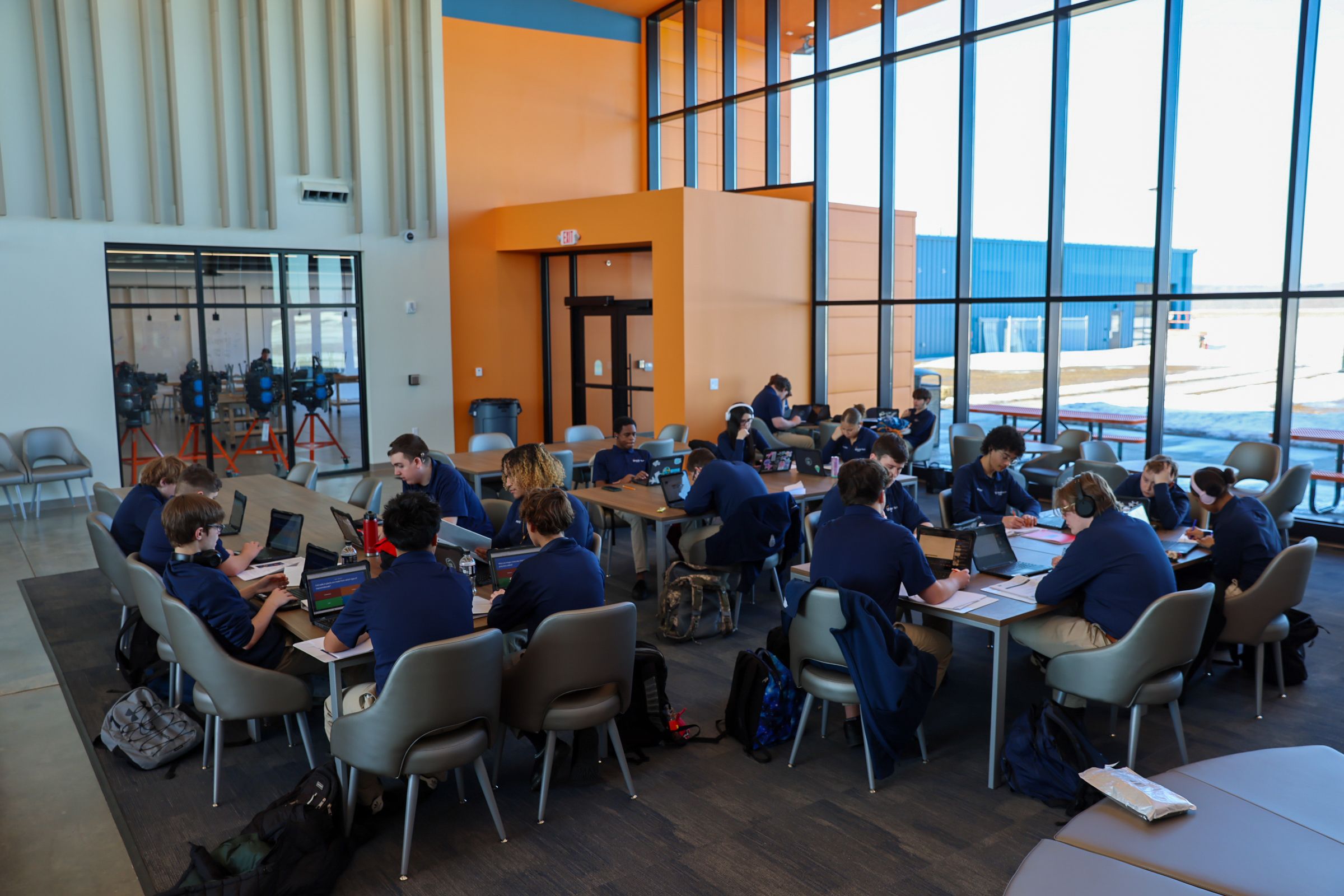
Students at the Butler Tech Aviation Center in Middletown, Ohio
Taking Flight in High School
MIDDLETOWN, Ohio — Demand for workers in the aviation industry is on the rise in Southwest Ohio, with 1,300 new roles for maintenance technicians projected by 2030, in addition to thousands of jobs for engineers, pilots, and air traffic controllers.
The new Butler Tech Aviation Center gives high school students an early start in breaking into the growing industry, with a novel three-year academic program packed with work-based learning. Local officials describe the $15.5M workforce development hub, which opened here in January, as an investment in both kids and the regional economy.
“People are looking for career fields that are steady and growing,” says Adam Snoddy, principal of the center, which is located next to the Middletown Regional Airport.
Student interest isn’t a challenge, and not just because of career stability. Groups of eighth graders were visiting the facility on a recent morning, with uniform-wearing aviation center students leading the tours. The middle schoolers’ eyes lit up when they walked into the 8K-square-foot hangar and saw two airplanes, engines, and various tools.
“It’s got that wow factor,” Snoddy says. “The hangar is the one part, more than anywhere else, where it pops.”
Students get more career exposure in ninth grade, with a full immersion day at the center. Those who apply and are accepted by the public career-tech school enroll in 10th grade. Their coursework and training during the first year are designed to build a strong foundation in aviation.
The curriculum becomes specialized in 11th grade, as students choose a learning path in piloting, maintenance, or engineering for the next two years. Hands-on and project-based learning is a focus throughout, and students complete with a personalized capstone experience during 12th grade. The open-concept center features labs and flight simulators, with each room serving multiple purposes.
Butler Tech serves roughly 41K students a year across six high school campuses and two adult education locations, with one more on the way. CTE enrollment is way up across the system, with growing demand for Butler Tech’s advanced manufacturing hub and bioscience center.
The aviation program can enroll more students with its new stand-alone facility, growing from 50 students per semester to 150. It also is seeking to add an adult education track in maintenance for recent high school grads.
Butler Tech tapped a range of sources to pay for the new center, including $7M each from the career-tech system and Butler County, which drew from federal funding. The city contributed $500K, and an additional $1M came from JobsOhio, a unique private, nonprofit development corporation that’s wholly funded by managing the state’s liquor enterprise.
Snoddy, a former social studies teacher, describes the braided funding approach as an example of community and economic development, saying the center “would not have been possible without one-time funding from multiple partners.”
In addition to classroom and lab instruction, the aviation students can earn both FAA-recognized certifications and college credits. In a brief ceremony at the center on this recent day, an instructor recognizes two students who earned commercial drone pilot licenses. Both are awarded a specialized patch for the sleeve of their uniforms.
Next up is the center’s maintenance instructor, who celebrates the first student to complete that pathway. It’s the student’s last full day at the center—he starts a full-time apprenticeship the next week.
Also visiting today to speak with students is a pilot from NetJets, a Columbus-based company. And workers from Modula, an Italian manufacturing company with a nearby facility housed at the former printing plant of the Dayton Daily News, are installing a large vertical storage unit in the center’s hangar.
Middletown is a short drive from Cincinnati and Dayton, both of which have thriving aviation sectors. Butler Tech partners with a growing number of companies across the industry, which Snoddy says is in the “economic DNA of the region.” Many of the students are willing to work in Cincinnati or beyond for the right gig, he says.
The Kicker: “They will have no problem finding a job,” says Snoddy. “Don’t underestimate your kids.”
Expanding High School Internships
Internships can help high school students find a path to a good career while also developing workforce-ready talent for local employers. To help meet this demand, Genesys Works is bringing its high school internship model to Nashville this summer.
Nashville will be the ninth U.S. market for the nonprofit, which creates paid internship opportunities for students in underserved communities. In November, a first cohort of students began their year-long internships in Jacksonville, the most recent city added by Genesys Works.
“Businesses need to offer early real‑world exposure that helps young people discover their strengths sooner—especially in fast‑growing STEM and vocational fields where hands-on experience matters most,” says Karl Sprules, the Nashville-based COO at AllianceBernstein, a large investment firm and one of 245+ corporate partners of Genesys Works.
The first step for participating students is 160 hours of summer instruction, which includes a mix of durable and technical skills. Then, during 12th grade, interns work 20 hours per week, earning an average of $14 per hour. They are placed in entry-level roles across IT, operations, HR, marketing, and finance. Genesys Works is the employer of record, handling logistics, training, and support for interns.
Many employers now want workers with one to three years of experience for entry-level jobs, says Byron Garrett, who took the helm in October as the group’s CEO. Likewise, the tsunami of AI-generated résumés makes a job referral even more important.
“It’s not just about learning the technical skills and doing a great job at your internship in high school,” Garrett says. “It’s about making connections that can help you get other internships through college and then a full-time job offer.”
Genesys Works provides college and career coaching to students during their internships, including help with applications and certification training. The nonprofit also supports its 14K+ alumni.
While the internships typically have been focused on IT roles, Genesys Works is diversifying the industries covered, with an increasing focus on healthcare among the customized offerings across its nine markets, including the Nashville program.
“In Tulsa, we have interns at a hospital who are sterilizing instruments for surgeries and learning which sets belong to which surgeries,” says Garrett. “In Jacksonville, we have interns at the Mayo Clinic.”
Genesys Works has incorporated AI into its training. Garrett says many high schools don’t encourage their students to experiment with AI, while employers say they want workers to use the tech.
“We’re bridging that disconnect, providing a foundation for how to think about and use AI in a professional setting that they can then build on once they get to the office,” says Garrett. “Being able to learn on the job in the first few months and then go on to do meaningful, productive work for the rest of the year is a major reason why employers partner with us.”
The group’s results are impressive, with 90% of its graduates enrolling in college. With a median wage of $70K seven years after completion, two-thirds of alumni outearn at least one parent.
Genesys Works is backed by a mix of philanthropic support and corporate revenue. Garrett says AI and the shifting economy are driving urgency among employer partners. Many recognize that if they want midlevel and senior workers, they need to invest in entry-level employees who are eager to gain skills and comfortable with new tools and technologies.
Sprules is optimistic that Genesys Works’ high school internship model can continue to expand. “By aligning student development with real employer needs, it creates lasting value and can be replicated across regions without losing impact.”
Open Tabs
Short-Term Credentials
The Higher Learning Commission has endorsed a first group of noncollege providers for meeting quality standards with workforce-related short-term credentials. Getting the nod from the accrediting agency were the Corporate Finance Institute, Kaplan North America, Sophia Learning, and Voltage Control. The new form of quality assurance from HLC seeks to help learners, employers, and others navigate the credential market.
AI and Jobs
Research on AI’s impact on the labor market has barely scratched the surface, writes Jed Kolko, an economist and senior fellow at the Peterson Institute for International Economics; even the most robust of those findings should be read skeptically, in part because AI is advancing so rapidly. Kolko calls for more of a research focus on the tech’s impact on productivity, labor supply, and short-term job dislocation and displacement.
Tech Hiring
While demand for tech talent remains strong in the greater Washington, D.C., area, entry-level hiring has declined as AI automates routine tasks and raises expectations for early-career roles, finds an analysis from the Greater Washington Partnership and Deloitte. The research, which was based on input from major employers, suggests that education programs will likely need to pivot, emphasizing higher-order skills earlier in coursework.
AI and Economies
The new Anthropic Institute seeks to share research about societal challenges related to AI, including how AI systems will reshape jobs and economies. The institute’s interdisciplinary team includes machine learning engineers, economists, and social scientists. Its founding hires include Anton Korinek, who is on leave from his role as a professor of economics at the University of Virginia. The center also is hiring a small analytical staff.
Education Grants
The administration this week kicked off the annual grant competition for federal TRIO programs—emphasizing that this will be one of the first processes run jointly by the Departments of Education and Labor. Management of TRIO grants was detailed to the Labor Department last year as part of the administration’s move to more closely align workforce and education programs and to dismantle the Education Department.
Job Moves
Susan Murray has been hired as CEO of Year Up United, a major sectoral training and workforce development nonprofit. The former interim CEO, Murray has worked at the organization for 15 years. Ellen McClain stepped down in November as Year Up United’s CEO and president.
The Job’s first issue went live five years ago. Thanks to all of you for reading, and to the sources and donors who make this coverage possible. If this newsletter was forwarded to you, subscribe here. —PF