- The Job
- Posts
- Workforce Hub
Workforce Hub
Austin Community College goes big with a new home for its Infrastructure Academy.

Paul Fain
May 14, 2026
A campus for skilled trades in Travis County seeks to meet evolving needs of employers and help more residents benefit from a booming local economy. Also, a new healthcare apprenticeship initiative puts employers in the driver’s seat, a big change for Brookings Metro, and an essay on why career “readiness” isn’t enough but apprenticeships could be. (Subscribe here.)
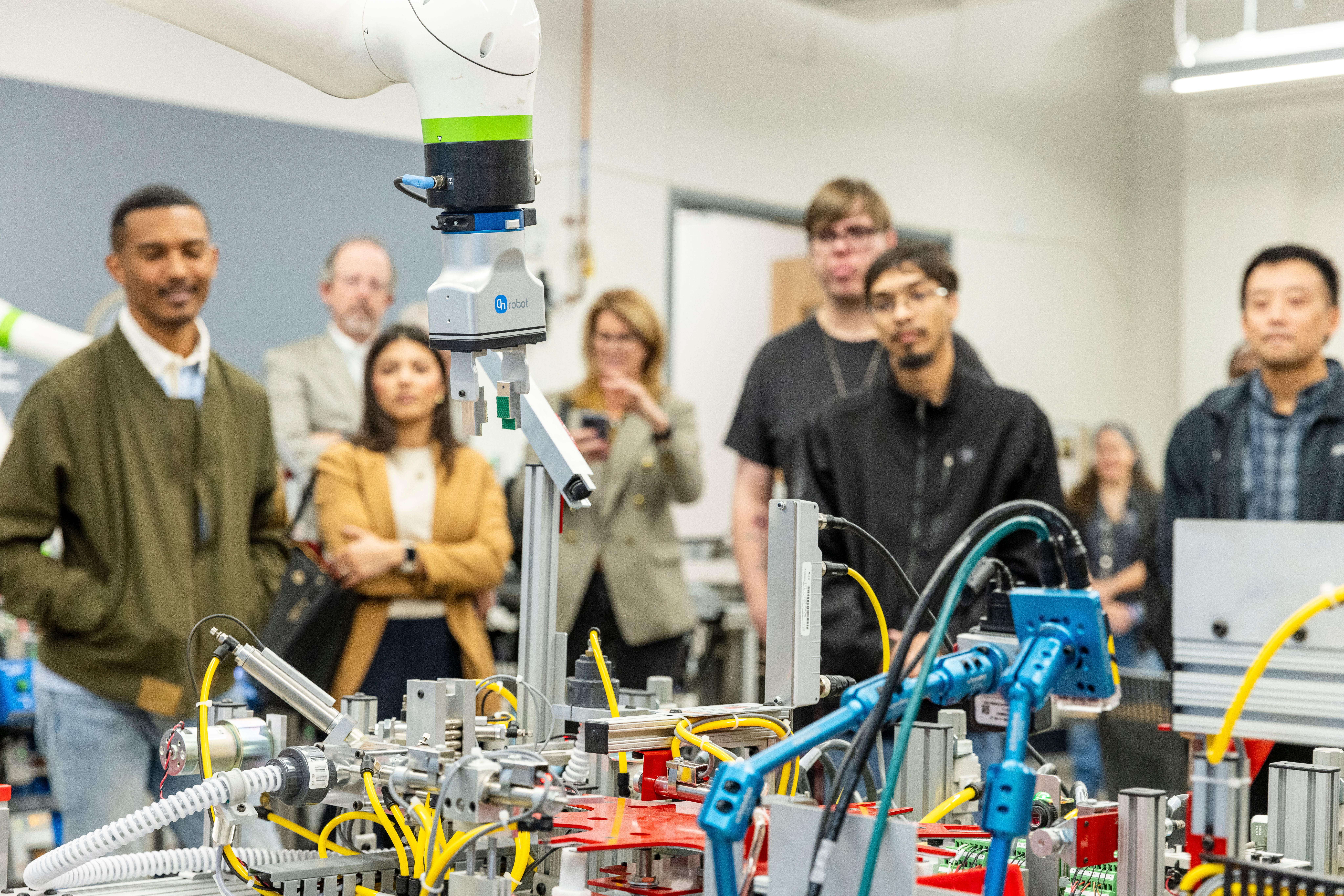
Advanced manufacturing lab at Austin Community College. (Courtesy of ACC)
Opening Doors in Central Texas
Austin is still booming. An estimated $25B in infrastructure projects in the region are creating thousands of good jobs that don’t require four-year degrees. And voters overwhelmingly support paying to expand training programs from Austin Community College, the region’s only two-year college.
But Austin also faces plenty of challenges, including expensive housing and a severe wealth gap, as well as horrible traffic and lackluster public transportation. Low-income residents won’t be able train for job opportunities if they can’t get to an ACC campus or find affordable childcare.
That’s why the community college just made a $130M bet on a new location in southeast Travis County. The 560K-square-foot complex will be home to its Infrastructure Academy, preparing students for careers in advanced manufacturing, construction, automotive, HVAC, and other high-growth industries across the skilled trades and applied technology. The workforce hub will be ACC’s second-largest campus.
Austin needs to train 10-15K workers a year for infrastructure jobs, up from the current level of about 6K. That will require tight partnerships between the community college and unions, employers, and the workforce board, says Russell Lowery-Hart, ACC’s chancellor.
“We’re trying to activate with urgency, gluing all these pieces together,” he says.
The project could be a national model for connecting educational pathways with workforce needs, says Lisa Larson, CEO of the Education Design Lab: “By repurposing space to create a hub, the college is effectively linking high-demand skills training to regional infrastructure projects.”
ACC expects to start offering classes at the campus this summer. It can move faster by renovating the existing complex rather than building a new one, saving $100M in the process. The first phase will serve up to 3K students at the campus, which is next to Austin-Bergstrom International Airport, with room to expand.
Voters passed a $770M bond four years ago that funded the purchase. That money also can be tapped to help provide childcare, transportation, and other supports for students. A new “unified system” for wraparound supports is an improvement on the bureaucratic past, Lowery-Hart says, where services were spread around the city and available from various providers.
“The resources are here,” he says. “We’ve not had systems to access those resources in a collective manner.”
One Front Door: The Infrastructure Academy is a public-private partnership, involving the city, Workforce Solutions Capital Area, and other training providers besides ACC. And strong ties with employers, large and small, will be crucial to making the new campus succeed.
“There’s a deep need for infrastructure beyond what any individual partner can solve on their own,” says Lowery-Hart. “Need drives partnerships.”
The college is integrating the skills wanted by businesses across its education and training programs, he says. For example, Lowery-Hart points to Samsung and Tesla, which have co-created curricula with ACC. Meanwhile, the college is working with employers to develop pre-apprenticeships and other training pathways as the rapid development of local data centers drives demand for electrical roles and for workers across the building trades and construction technology.
Likewise, the Infrastructure Academy features a core curriculum from TradesFutures for a free short-term training program to prepare students for apprenticeships and careers in construction.
“They’re directly telling us what they need,” Lowery-Hart says of ACC’s corporate and union partners.
The college also is pursuing partnerships where businesses hire students and pay for their education in exchange for a commitment to work at the company—a model that has emerged in healthcare that ACC is applying to infrastructure roles.
“Employers understand they’re going to have to invest in ways they haven’t previously,” says Lowery-Hart.
Bringing many stakeholders together in a shared space is a smart move, says Larson, a former community college president.
“It puts these programs and models in one place with one front door,” she says, “where faculty, employers, and community partners can co-design new or retrofit programs, pathways, training, technology, and labs and key wraparound services to meet both learner and fast-changing employer needs.”
A growing number of community colleges are making strategic investments in workforce-aligned innovation hubs focused on emerging industries and regional economic development, says Erika Liodice, executive director of the Alliance for Innovation & Transformation, a membership group for higher ed CEOs, many of whom lead two-year colleges.
These hubs aren’t traditional workforce centers. Instead, she says, they are multidisciplinary innovation ecosystems that blend workforce training, applied learning, industry partnership, entrepreneurship, and tech commercialization under one roof. She cites these examples:
Colorado’s Aims Community College’s Aims Workforce Innovation Center
Wisconsin’s Western Technical College’s Wanek Center of Innovation
Central New Mexico Community College’s Quantum Learning Lab
“Colleges can no longer afford to simply react to labor market shifts after they happen,” Liodice says. “Increasingly, they are attempting to shape regional economic futures by co-creating talent pipelines with employers in emerging sectors before workforce shortages become critical.”
Close ties with companies are particularly important for fast-changing industries, says Lowery-Hart. For example, he led Amarillo College before becoming ACC’s chancellor in 2023. The two-year college has worked to connect students with the fast-growing wind energy industry. But Lowery-Hart says the technology changed quickly and now requires fewer technicians to maintain wind turbines.
ACC wants the Infrastructure Academy’s new home to be a place where training evolves in tandem with jobs, so more people in greater Austin can benefit from the region’s economic boom.
The Kicker: “Central Texas is the heartbeat of the Texas Miracle,” says Lowery-Hart.

Uncertain Future for Brookings Metro
Brookings Metro is an important nonpartisan voice on workforce education and training, with researchers who produce cutting-edge studies with local angles. So I was concerned to hear that Brookings is dissolving Metro.
A Brookings spokesperson acknowledged the move, but said the vertical’s research would continue:
“As part of our strategic plan, Brookings will reimagine our internal organizational structures to break down research silos and increase our collective impact. Though we are moving from five research programs to three, the work of Metro is not going away and remains as critical as ever.”
Like most major nonprofits, Brookings relies heavily on philanthropic support. That has become a trickier proposition of late for some organizations. Many foundations have been shifting their focus amid AI and the policy chaos in Washington. And sources tell me grants seem more unpredictable these days.
I don’t know how much of a factor the fundraising environment was for Brookings in making this decision. But I hope the researchers at Metro can keep doing their thing.

Open Tabs
WIOA and AI
Training through the Workforce Innovation and Opportunity Act rarely helps workers move into jobs with lower automation risk, and many workers simply return to their previous field, find researchers at Google DeepMind and the Forecasting Research Institute. Registered apprenticeship has been the most successful with transitions but is still a relatively rare training path. The paper argues that WIOA overall is not well positioned to help workers who may have to shift amid the rise of AI.
Training Electricians
The BlackRock Foundation will invest $30M to help train more than 12K Texans for electrical careers. The new funding is part of the investment giant’s $100M Future Builders program, which is backing nonprofit and workforce development partners to strengthen skilled trades pipelines across the U.S. Texas is an early indicator of national infrastructure and workforce pressures, says BlackRock, and will need thousands of additional licensed electricians.
Ed+Work in Georgia
A new law signed in Georgia this week sets up the state’s technical college system as its State Apprenticeship Agency, making it the latest state to move apprenticeship registration from federal to state hands. The law also rechristens the governor’s Office of Student Achievement as the Office of Education and Workforce Strategy and gives it a wider purview, combines WIOA and Perkins planning into one process, and creates a unified state workforce plan.
Workforce Pell
Iowa last week launched its application for federal Workforce Pell grants. The Iowa Department of Education, which said the state is the first to go live with its application system, published eligibility criteria and technical guidance for institutions. Program applications go to the State Workforce Development Board for consultation, then to the governor’s office for state approval, with approved programs being forwarded to the feds for final sign-off.
Quantum Jobs
The Chattanooga Quantum Collaborative and BuildWithin have created what may be the nation’s first quantum pre-apprenticeship. The paid 12-week program is built on the federal apprenticeship framework and designed to prepare workers to lead quantum adoption inside their companies. The small pilot program is backed by the National Science Foundation through a grant to the University of Tennessee at Chattanooga Research Institute.
AI for Good
Humanity AI, a project from 10 foundations seeking to ensure that AI serves the public good, announced $8M in grants and another $10M for an “open call” this summer. The $8M in pooled grants will go to organizations that work on AI and safeguarding democratic institutions and worker rights, strengthening journalism, and advancing education. The project also will support AI Civics, a new effort focused on public education, literacy, and community decision-making.
Thanks for reading. If this newsletter was forwarded to you, subscribe here. —PF